
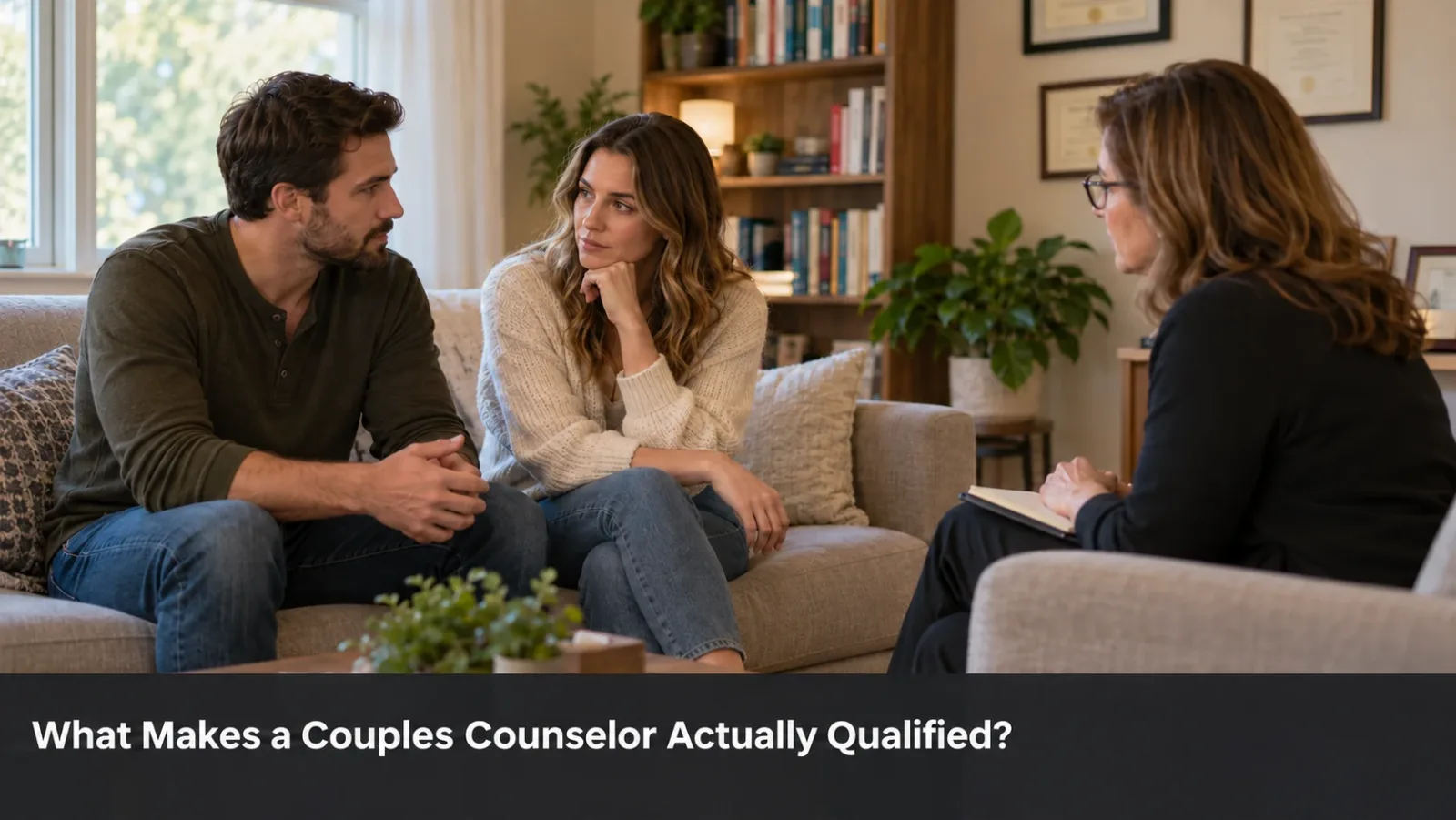
A qualified couples counselor has specialized training in a recognized couples therapy model, such as Gottman Method Couples Therapy or Emotionally Focused Therapy, plus supervision or consultation from an expert in couples work. A general therapy license alone is not enough.
Experience matters most for complex cases involving trauma, neurodivergence, or personality disorders. A qualified counselor also screens for safety concerns like domestic violence, knows when individual therapy should come first, and keeps sessions focused. Before booking, ask which model they use, what couples training they have, and how they decide if couples therapy is appropriate.
Not every counselor is qualified to treat couples. Having a license to practice therapy does not automatically mean someone has the training or experience needed to help two people work through relationship problems.
Couples therapy is different from individual therapy. It requires specialized training, an understanding of relationship dynamics, and the ability to work with two people whose needs, feelings, and experiences may be very different.
I've worked with couples dealing with everything from communication problems to complex situations involving trauma, neurodivergence, and personality disorders. I've also worked with people whose previous couples therapy left them feeling worse about their relationships.
So what should you look for in a qualified couples counselor? In my experience, three things matter most:
- Specialized training in actual couples therapy methods.
- Supervision or consultation with an expert in couples therapy.
- Experience working with relationship problems, especially complex cases.
Let's look at why each of these matters and what you should know before choosing a counselor.
1. Does Your Couples Counselor Have Specialized Training?
One of the biggest mistakes people make when looking for couples counseling is assuming that any licensed counselor can provide effective couples therapy. That's simply not true.
Counselors receive general clinical training as part of their education. However, working with couples requires additional knowledge and skills that aren't necessarily covered in depth during graduate school (Commission on Accreditation for Marriage and Family Therapy Education, 2021; Council for Accreditation of Counseling and Related Educational Programs, 2023).
A counselor needs to understand how relationships function, how couples get stuck in unhealthy patterns, and how to help both partners make meaningful changes. They also need to know how to work with the relationship itself, rather than treating the couple as two individuals who happen to be sitting in the same room.
What Couples Therapy Training Should You Look For?
Look for formal training in recognized models, such as Gottman Method Couples Therapy and Emotionally Focused Couples Therapy (can also be called EFCT, Emotionally Focused Therapy, or EFT). For a closer look at what it means to practice a model rather than just borrow its techniques, see The Real Reason Couples Therapy Stalls.
A qualified counselor should be able to explain what model they use, why they use it, and how it applies to your relationship.
2. Has Your Counselor Received Supervision or Consultation in Couples Therapy?
Training is important, but learning a therapy model in a classroom isn't the same as using it with real couples. That's where supervision and consultation come in.
A counselor who is learning couples therapy should receive guidance from someone with expertise in treating couples. An experienced supervisor or consultant can help the counselor recognize problems they might otherwise miss, understand complicated relationship dynamics, and improve their clinical skills.
This matters because counselors don't always know what they don't know. I've been practicing for years, and I still consult with other counselors. If I'm working with a difficult case and another professional has more expertise in a particular area, I'll seek their input.
I also regularly discuss cases with other counselors, without sharing identifying information, so we can learn from each other's experience.
Experience doesn't mean you stop needing consultation. It means you become better at recognizing when consultation would help.
3. How Much Experience Does a Couples Counselor Need?
Everyone has to start somewhere. A counselor who is new to couples counseling can absolutely help couples, especially when they're properly trained and receiving good supervision. But experience becomes increasingly important when couples have complicated problems.
Communication Problems Aren't Always Just Communication Problems
Many couples describe their problem as communication, but the underlying clinical issues can be more complicated. I discuss the limitations of communication-only treatment in The Real Reason Couples Therapy Stalls.
I've worked with several couples whose communication difficulties were connected to a combination of:
- Past trauma or PTSD.
- ADHD, autism, or other forms of neurodivergence.
- Personality disorders.
- Difficulty managing emotions.
- Problems with boundaries and family relationships.
In some cases, all these issues were present in the same relationship.
How I Approach Complex Couples Therapy Cases
I start with an assessment. Before deciding how to treat a couple, I need to understand what I'm dealing with. Once I've identified the problems affecting their relationship, I can determine which treatment approaches are appropriate.
Depending on the couple, I may combine different methods, including:
- Gottman Method Couples Therapy or EFT: To address relationship patterns and improve the connection between partners.
- Dialectical Behavior Therapy (DBT) skills: To help with emotional regulation and difficulties associated with some personality disorders.
- EMDR or other trauma-focused therapies: To address trauma when clinically appropriate.
- Structural Family Therapy: To address boundaries, family roles, and relationship dynamics.
- Neurodivergence education and therapy: Neuroaffirming individual therapy can help partners better understand differences in how they think, communicate, and process information.
- Psychoeducation: To help both partners understand the issues affecting their relationship.
Not every couple needs all these approaches. The point is that treatment should fit the couple, rather than forcing every couple through exactly the same process.
In my experience, outcomes are often good when these underlying issues are identified and addressed. However, complex cases usually take longer than cases involving communication skills alone.
And not every couple benefits from couples therapy. Sometimes individual treatment needs to happen first.
4. What Are the Red Flags of an Unqualified Couples Counselor?
A major red flag is a counselor who gives directives, takes sides, or acts like a friend rather than providing therapy. Another is a lack of an intentional treatment model. I explain the consequences of unstructured treatment in The Real Reason Couples Therapy Stalls.
Giving Advice Isn't the Same as Doing Therapy
A counselor's job isn't to decide how clients should live their lives. Client autonomy is an important part of professional ethics (American Association for Marriage and Family Therapy, 2026). Counselors are supposed to help clients make informed decisions, not make those decisions for them.
That doesn't mean counselors should never offer information, suggestions, or professional guidance. But there's a significant difference between helping clients evaluate their choices and telling them what they must do.
I've seen counselors approach couples counseling as though their job is to tell each partner what they're doing wrong.
When Couples Therapy Makes Things Worse
I've worked with people who came to me after unsuccessful experiences with other couples counselors. One particularly memorable situation involved a couple who had previously seen a well-known counselor who reportedly charged around $800 per hour at the time.
Despite the expense, the couple felt they hadn't received meaningful help. In fact, the experience left one partner so discouraged that they were no longer willing to participate in couples therapy.
The other partner still wanted to work on the relationship, so I ended up providing individual therapy to help that person address their own communication difficulties.
I can't say exactly what happened in those earlier sessions because I wasn't there. But I can tell you that the experience had a significant effect on the couple's willingness to try therapy again.
I've also encountered couples who spent years in counseling without making meaningful progress. If a couple has been attending therapy for months without improvement, something needs to be reassessed.
That doesn't automatically mean the counselor is incompetent or the couple isn't trying. But continuing the same approach indefinitely without examining why it isn't working doesn't make sense. In my own practice, if I'm not seeing progress, I start asking what I need to change.
5. Does the Counselor Know When Couples Therapy Isn't Appropriate?
One of the most important skills a couples counselor needs is knowing when not to provide couples therapy. Just because two people want to work on their relationship doesn't mean they're ready for joint sessions.
Safety Comes Before Relationship Work
The first thing I consider when assessing a couple is safety. Are there concerns involving:
- Domestic violence or abuse?
- Coercive control?
- Threats of harm?
- Suicide risk or serious self-harm concerns?
- Severe emotional dysregulation that makes joint therapy unsafe or unproductive?
These issues need careful assessment before proceeding. For example, when domestic violence or coercive control is present, traditional couples therapy may be unsafe (Gottman & Gottman, 2016).
A counselor must consider what could happen after the session ends. Could one partner face retaliation for something they said during therapy? Could discussing a sensitive issue put someone in danger when they return home?
In situations involving ongoing abuse or coercive control, specialized safety planning and individual interventions may be needed instead of conjoint therapy. The goal isn't simply to get two people talking. It's to make sure the therapeutic process doesn't put either person at greater risk.
When Emotional Regulation Becomes a Barrier
I've also encountered couples who seemed ready to begin relationship work during the assessment process. Then we started using actual couples therapy interventions. Suddenly, one partner became so emotionally overwhelmed that we couldn't continue the session productively.
Sometimes the counselor can help the person regulate enough to resume. Other times, that's simply not possible.
I've had situations where a partner became so dysregulated that I had to separate the couple during the session. I've also had couples return the following week and report that one partner remained upset after the previous session, creating serious conflict at home.
When two people cannot discuss even minor relationship concerns without losing control, pushing ahead with couples therapy may do more harm than good. Sometimes I recommend individual treatment first so one or both partners can develop the skills needed to participate safely and effectively.
Knowing when to pause couples therapy is part of being a qualified couples counselor.
6. Can Your Couples Counselor Keep Sessions Focused?
Sometimes I have to stop a couple from venting and bring them back to the work. I can empathize with their frustration without letting the session become another argument. If sessions repeat without movement, that deserves reassessment. For more on why therapy can stall, read The Real Reason Couples Therapy Stalls.
7. How Does a Qualified Couples Counselor Keep Their Skills Current?
Therapy isn't a profession where you finish school, get licensed, and never need to learn anything else. New research, treatment methods, and clinical approaches continue to develop. And couples bring increasingly complex combinations of issues into treatment.
Continuing Education Should Go Beyond License Requirements
I've never met a training opportunity I didn't like. I'm constantly taking additional training in couples therapy, discernment counseling, autism, ADHD, personality disorders, trauma treatment, and other areas that may help the people I work with. I also maintain several professional certifications that require continuing education. I complete far more continuing education than I need simply to renew my license.
Why? Because I regularly encounter situations where knowing more about a particular condition or treatment approach could make a difference. When I see training that might help me work more effectively with a certain type of couple, I take it.
That doesn't mean every training is equally valuable or that collecting certificates automatically makes someone a better counselor. It means I'm committed to continuing to develop the clinical skills my clients need.
Even Experienced Counselors Need Consultation
Another part of staying effective is recognizing the limits of your own expertise. I consult with other professionals when I'm working with challenging situations.
Sometimes another counselor has specialized knowledge that I don't. There's nothing wrong with that. I would be more concerned about a counselor who believes they have nothing left to learn.
A qualified couples counselor should be able to recognize when a case is outside their competence, seek consultation, or refer clients to someone better suited to their needs.
8. What Questions Should You Ask Before Choosing a Couples Counselor?
You don't need to understand every couples therapy model to make an informed decision. But you should feel comfortable asking a counselor about their qualifications and approach. Here are some questions I recommend:
- What specialized training have you completed in couples therapy?
- Which couples therapy models do you use?
- Have you received supervision or consultation specifically in couples therapy?
- How much experience do you have treating couples?
- Have you worked with couples facing problems similar to ours?
- How do you determine whether couples therapy is safe and appropriate?
You don't need a counselor who has treated every possible relationship problem. You need someone who has the training and experience appropriate for your situation and who recognizes the limits of their expertise.
A counselor who says, "That's not my area of expertise, but I can help you find someone who specializes in it," may be demonstrating better professional judgment than someone who claims they can treat everything.
What Really Makes a Good Couples Counselor?
A qualified couples counselor needs more than a license, a comfortable office, and a willingness to listen. They need specialized training in couples therapy, appropriate supervision or consultation, and enough clinical experience to understand the problems they're treating.
They also need good judgment. That means knowing when to adapt treatment, when to seek consultation, when to recommend individual therapy, and when couples therapy may not be safe or appropriate.
In my own practice, I use established couples therapy models, assess each couple's needs, and adjust treatment when underlying issues require additional approaches. I continue taking advanced training and consulting with other professionals because no counselor knows everything.
The goal of couples therapy isn't simply to help two people talk about their problems. It's to help them make meaningful changes in their relationship. That's what you should expect from a qualified couples counselor.
References
American Association for Marriage and Family Therapy. (2026). AAMFT code of ethics. https://www.aamft.org/common/Uploaded%20files/Legal%20Ethics/AAMFT%20Code%20of%20Ethics.pdf
Commission on Accreditation for Marriage and Family Therapy Education. (2021). Accreditation standards: Graduate & post-graduate marriage and family therapy training programs (Version 12.5). https://coamfte.org/Common/Uploaded%20files/COAMFTE/Accreditation%20Resources/COAMFTE%20Standards%20Version%2012.5%20-%20Published%20August%202021%20-%208.26.21%20(with%20links).pdf
Council for Accreditation of Counseling and Related Educational Programs. (2023). 2024 CACREP standards. https://www.cacrep.org/wp-content/uploads/2023/12/2024-CACREP-Standards.pdf
Gottman, J. M., & Gottman, J. S. (2016). Level 1 clinical training: Gottman Method Couples Therapy: Bridging the couple chasm [Training manual]. The Gottman Institute.
