
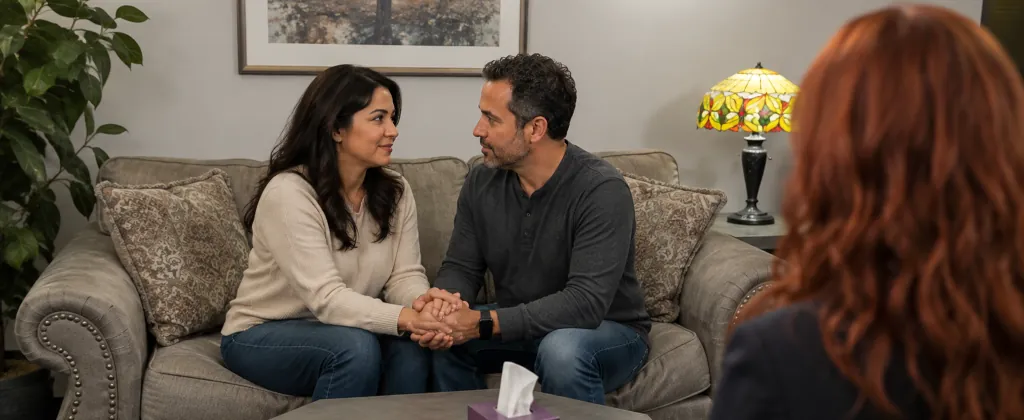
What is Couples Counseling?
Looking for couples counseling in Columbus, Ohio or elsewhere in the state of Ohio? Couples counseling, also known as relationship therapy or marriage counseling, is a form of psychotherapy that focuses on helping couples resolve conflicts, fix relationship problems and improve their relationships. It involves working with a trained therapist who specializes in helping couples navigate through difficulties and find healthier ways of communicating and relating to each other. Most couples who use these counseling services have already tried to improve their relationships on their own, and have decided they need professional help.
The primary goal of couples counseling or relationship therapy is to improve relationship issues by facilitating open and honest communication between partners, enhancing understanding and empathy, and promoting positive change within their relationships. The therapist provides a neutral and supportive environment where both partners can express their thoughts and feelings without judgment.
Marriage counseling is not only for couples on the edge of divorce. Many couples come in when things feel stuck, distant, or repetitive – not necessarily catastrophic. The work is practical: a therapist helps you see what is actually happening between you, not just who said what in the last argument.
The goal is not to assign blame or keep the peace at any cost. It is to give both partners a clearer picture of the relationship and a more useful set of tools for what comes next.
Marriage counseling or couples counseling typically involves regular sessions with the therapist, either individually with each partner or together as a couple. The duration and frequency of sessions depend on the specific needs and goals of the couple. The therapist may also assign homework or provide tools and techniques to practice outside of the sessions to promote ongoing progress.
Before therapy begins, both partners sign our limited secrets policy, which explains how information shared privately with the therapist may be brought into joint sessions.
Premarital Counseling

Why Couples Choose Revitalize You for Marriage Counseling

Most therapy practices describe themselves the same way. Revitalize You is built differently: the focus is on helping couples move through the work efficiently, not keeping them in therapy longer than necessary.
- Licensed therapists serving Columbus, Ohio
- Evidence-based methods including Gottman Method Couples Therapy, Emotionally Focused Therapy, DBT skills, and EMDR therapy integration when trauma is part of the picture
- Assessment-first approach: no generic treatment plans; the therapist understands your specific history, patterns, and goals before recommending a direction
- Specialized support for high-conflict couples, neurodivergent couples, couples affected by trauma, and couples navigating personality disorders or entrenched personality-related patterns
- Inclusive practice serving LGBTQIA+ couples, couples at all relationship stages, and couples from all backgrounds
- Broad scope: communication breakdown, repeated conflict, infidelity recovery, intimacy loss, premarital preparation, and separation or co-parenting decisions
- Cash-pay, private practice: no insurance billing, no third-party involvement in your care
- Appointments typically available within 7 days
Types of Couples Counseling We Offer
We offer many types of couple therapy. This is because each couple is different. Instead of trying to use the method we prefer and fitting your particular scenario into our method. We fit the method to your particular circumstances. This means that you will get customized care, dependent entirely on your needs.
Gottman Method Couples Therapy
One method of couple therapy that we use is Gottman Method Couples Therapy. This type of therapy is backed by over 40 years of research with couples. The method provides concrete guidelines for determining what issues a couple is facing, and how to help fix them.
Gottman Method Couples Therapy is a skills-based method, and teaches couples how to improve their relationships by learning to effectively communicate, as well as building trust and friendship. Gottman Method Couples Therapy must be delivered by licensed therapists with specialized training.
Emotionally Focused Couples Therapy
Another couple therapy method we use is Emotionally Focused Couples Therapy. This is also called Emotionally Focused therapy, EFT, and EFCT interchangeably. This evidence-based therapy is also backed by over 40 years of research.
Instead of focusing on the content of a couple’s arguments, emotionally focused therapy helps them to look at the overall pattern that they are stuck in that causes the fights. Once this pattern is identified, it can be changed, leading to a more fulfilling partnership. Emotionally focused therapy must be delivered by licensed therapists with specialized training.
Marriage and Family Therapy
Marriage and Family Therapy is a specific type of therapy. A Marriage and Family Therapist (MFT) is also a specific type of therapist license. MFTs are licensed by the Ohio Counselor, Social Worker and Marriage and Family Therapist Board.
Marriage and family therapy views you and your situation in a holistic way. An MFT sees the family or couple as a unique and living relationship, that is greater than the sum of individuals. An MFT will also look at your situation in context. Issues are not considered issues with one person, but can stem from outside forces such as work, culture and other forces that act on the relationship.
Because we use marriage and family therapy, we do not assume that any one person is the “problem” in a couple. We also do not assume that the couple is the issue. Often, many things play into marital problems such as culture, expectations, families and work-life-balance. All of these need to be considered in context.
Assessment for Couples Counseling

Before any treatment direction is recommended, the therapist takes time to understand the couple’s relationship history, current strengths, stuck patterns, goals, and individual context. This includes understanding whether trauma, neurodivergence, mental health concerns, or personality-related patterns are part of the picture.
This step matters because the right approach for one couple may be the wrong approach for another. Starting with a thorough assessment means the work is targeted from the beginning.
Methods Used in Marriage Counseling at Revitalize You
| Approach | What It Does | Best For |
|---|---|---|
| Gottman Method Couples Therapy | Research-based tools for communication, conflict management, friendship, and trust | Communication breakdown, repeated conflict, rebuilding connection |
| Emotionally Focused Therapy (EFT) | Addresses attachment needs and emotional cycles driving disconnection | Emotional distance, pursuit-withdrawal patterns, intimacy loss |
| EMDR Integration | Processes traumatic memories affecting relational responses | Couples where trauma is driving reactive patterns |
| DBT Skills | Emotional regulation, distress tolerance, interpersonal effectiveness | High-conflict couples, personality-related patterns, emotional dysregulation |
| Marriage and Family Therapy | Relational work in context: family systems, roles, culture, parenting, stress | Couples affected by family dynamics, parenting conflict, cultural pressures |
Why Integrative Matters
A therapist who only uses one method will apply it regardless of fit. An integrative approach means the therapist can shift tools when the work calls for it, combining Gottman communication skills with EFT attachment work, or adding EMDR when a trauma response is blocking progress in couples sessions.
The goal is to help couples move through the work efficiently. Revitalize You is not structured around keeping clients in therapy indefinitely. It is structured around helping them get clear, get unstuck, and move forward.
Appointments Available Now

When you are hurting, it is difficult to wait weeks or even months to get the support you need. If you are on this website, it is because you want to see someone as quickly as possible. Revitalize You offers appointments within the next week so that you can begin the healing process as quickly as possible.
Don’t want to skip work for therapy? We’ve got you covered. Evening and weekend appointments are available now.
Who Needs Couples Counseling?
Many types of couples can benefit from couples counseling. No matter your stage in the relationship or your stage in life, you can benefit from couple counseling.
Unmarried Couples Need Couples Counseling
As mentioned above, the best time to begin counseling is before the couple has problems. This is a great time to learn how to communicate with your partner and to disagree without fighting.
Married Couples Who Want To Become Closer
Married couples do not need to be fighting constantly to seek marriage therapy. Your therapist can help you build on your relationship’s strengths. She can also help you to see potential problems before they arise and plan for them.
Married Couples Facing Challenges
The majority of couples who seek counseling are those who are facing challenges in their relationship. Often, there is a lack of communication, feeling like they fell out of love, or are trying to blend their families. Having a therapist help you through times of trouble in your relationship can get the relationship back on track much quicker.
Couples Recovering From an Affair
Often, an affair can be the end of a relationship. It is one of the most difficult issues for a marriage or partnership to recover from. We are specialists in infidelity recovery. We can help both of you work through your emotions and decide if you want to remain in the relationship or move on.
Once that decision is made, we help separating couples end the relationship gracefully. Couples that choose to remain together will receive help processing the affair and recovering from the pain and mistrust that infidelity brings.
Married Couples With Mental Health Challenges
Mental health problems such as anxiety, depression, PTSD, ADHD and Autism Spectrum disorder can be difficult to manage. This is true for the person going through them, but also for the person’s partner and family. If you are in a partnership and one of you has a mental health issue, your therapist can help you understand how to support each other while still caring for your own needs.
Separating and Divorcing Couples
Couples who no longer wish to be in a marriage usually do not think of couple counseling. However, this is a great time to receive counseling to help you end the relationship amicably. This is especially important if there are children involved.
Co-Parents Can Benefit From Relationship Therapy
Co-parenting is difficult enough when you are married or in a happy relationship. After the end of a relationship, it is easy to let the pain of the relationship ending get in the way of being a good co-parent with your former partner. Your therapist can help you work through these problems to be the best parents possible for your children.
Signs Marriage Counseling May Help
You do not need to be in a full crisis to benefit from marriage counseling. Many couples come in when something feels off but they cannot name exactly what it is. Others wait until the situation is urgent. Both are valid starting points, though earlier is usually easier.
Consider reaching out if you recognize any of the following:
- You keep having the same argument and it never fully resolves
- One or both of you feels chronically unheard, dismissed, or misunderstood
- Conflict escalates quickly, or one partner shuts down and goes silent
- Trust has been damaged, whether by infidelity, dishonesty, or repeated letdowns
- Sexual or emotional intimacy has faded and attempts to reconnect feel awkward or rejected
- You feel more like roommates than partners
- Parenting differences, financial stress, work pressure, or extended family conflict is pulling you apart
- You are recovering from an affair and do not know whether repair is possible
- One or both of you is neurodivergent, and the relationship dynamics are harder to navigate than either of you expected
- Trauma, mental health concerns, or personality-related patterns are affecting how you relate to each other
- You are considering separation or divorce and want support making that decision thoughtfully
- You are engaged or planning to marry and want to start with a strong foundation
- Life transitions: Major life transitions such as starting a family, career shifts, relocation, or adjusting to an empty nest can strain a relationship. Couples counseling can help couples navigate these transitions more smoothly.
Starting earlier tends to make the work easier and more effective. Patterns that have been in place for years are harder to shift than patterns that are just beginning to emerge.
It is also useful for couples to have a routine relationship checkup with a therapist to avoid issues that might come up, or catch issues early on.
Marriage Counseling Issues We Help With
Relationship struggles rarely fit neatly into one category. The issues below often overlap, and the work in therapy reflects that. This section outlines the specific concerns Revitalize You addresses most often in marriage counseling.
Communication Problems
Communication problems are the most common reason couples seek counseling, and also one of the most misunderstood. The issue is rarely that partners do not talk enough. It is that the way they talk pulls them further apart instead of closer together.
Common patterns include:
- Criticism that attacks character rather than addressing a specific behavior
- Defensiveness that blocks the other partner from feeling heard
- Contempt, including sarcasm, eye-rolling, or dismissiveness
- Stonewalling, where one partner shuts down entirely to avoid escalation
These are the patterns Gottman research identifies as most predictive of relationship breakdown. In counseling, couples learn to recognize these cycles in real time and replace them with communication that actually moves the conversation forward.
Conflict Resolution
Conflict itself is not the problem. Every couple disagrees. The problem is conflict that repeats without resolution, escalates without repair, or leaves both partners feeling worse than before.
Counseling helps couples:
- Understand what is actually driving the conflict beneath the surface argument
- Set limits that both partners can respect without feeling controlled
- Learn repair skills that de-escalate tension before it becomes damaging
- Disagree without it becoming a threat to the relationship itself
The goal is not to eliminate conflict. It is to make conflict less destructive and more productive.
Infidelity and Affair Recovery
Infidelity is one of the most painful experiences a couple can face, and one of the most complex to work through. Counseling does not promise reconciliation, and it does not minimize what happened. What it offers is structure: a space to process the betrayal, understand what led to it, and make a clearer decision about whether repair is possible.
Affair recovery work typically involves:
- Creating accountability without repeated punishment cycles
- Rebuilding trust incrementally, not on demand
- Addressing the underlying vulnerabilities in the relationship
- Deciding together, with support, whether to repair or separate
Both outcomes, repair and separation, can be done with more clarity and less damage when there is professional support.
Intimacy and Emotional Disconnection
Emotional and physical intimacy often fade gradually, which makes the disconnection harder to name. Many couples describe feeling like they are living parallel lives, polite and functional but not actually close.
This kind of disconnection is common and treatable. Counseling addresses:
- The resentment or emotional distance that builds when needs go unmet
- Patterns of pursuit and withdrawal that keep partners stuck
- Physical intimacy concerns, including loss of sexual connection
- How to rebuild closeness when both partners feel they have already tried
Revitalize You also offers sex therapy for couples where sexual concerns are a primary focus.
High-Conflict, Neurodivergent, Trauma, and Personality-Related Patterns
Some couples face challenges that standard communication tools do not fully address. Revitalize You has specialized training in working with:
- High-conflict couples where arguments escalate quickly and repair feels impossible
- Neurodivergent couples, including those where one or both partners has ADHD, autism, or sensory processing differences that affect how they connect and communicate
- Couples affected by trauma, where past experiences are shaping present reactions in ways that are hard to see clearly
- Couples navigating personality disorders or entrenched personality-related patterns, including borderline, narcissistic, and other presentations that affect relational functioning
This is a clinical specialty, not a general offering. If your relationship struggles have felt too complex or too stuck for standard couples counseling, this level of training matters.
Premarital Counseling
Premarital counseling is not about fixing problems. It is about having the conversations that most couples avoid until those topics become conflicts. Revitalize You offers structured premarital support, which helps couples explore:
- Communication styles and conflict patterns
- Financial values and expectations
- Family of origin influences and parenting intentions
- Intimacy, affection, and physical connection
- Faith, values, and long-term life goals
Starting a marriage with this kind of clarity is one of the highest-return investments a couple can make.
Separation, Divorce, and Co-Parenting Support
Not every couple who comes to counseling is trying to save the marriage. Some are trying to make a difficult decision more clearly, or to separate in a way that causes less damage, especially when children are involved.
Counseling can help couples who are considering separation:
- Reduce reactive conflict during a painful transition
- Communicate more respectfully, even when trust is low
- Make decisions about the relationship from a clearer, less reactive place
- Build a co-parenting structure that protects children from adult conflict
Revitalize You does not provide court-ordered evaluations or court-ordered counseling. If you need that specific service, a different provider would be a better fit.
If you’re experiencing difficulties in your relationship, marriage counseling in Ohio can be a valuable way to resolve conflicts and improve communication. It can also help you and your partner learn how to deal with stress, trauma, and disagreements in a healthier way. Before you decide to seek counseling, it’s important to find a therapist who is qualified. Be sure to discuss your goals for counseling and what you hope to achieve. Don’t wait until things have gone too far – seeking help early from a couple counselor can make a big difference. Get help now before the situation gets any worse.
Online Marriage Counseling for Ohio Couples
Online marriage counseling works well for many couples, and it has become one of the primary ways therapy is delivered in Ohio.
Online counseling may be a practical fit if:
- Both partners can join from a private, quiet location where they feel safe speaking openly
- Work schedules, childcare, or distance make in-person sessions difficult to coordinate
- You live outside Columbus but want Ohio-based therapy from a practice with specialized couples training
- One partner travels frequently or works irregular hours
Online sessions are not a lesser version of in-person therapy. For many couples, the convenience removes a significant barrier to actually showing up consistently, which is one of the strongest predictors of progress.
If you are unsure which format fits your situation, that is something you can discuss when you book your first consultation.
Marriage Counseling Near Columbus Neighborhoods
Revitalize You serves couples from Columbus and across Central Ohio.
Couples regularly come to Revitalize You from neighborhoods and communities including Clintonville, Worthington, Grandview Heights, Short North, German Village, Bexley, Powell, Dublin, Hilliard, Westerville, Gahanna, New Albany, Grove City, Reynoldsburg, and surrounding Central Ohio areas.
Who Revitalize You May Be a Good Fit For
Not every practice is the right fit for every couple. This section is here to help you decide quickly whether Revitalize You matches what you are looking for.
Revitalize You may be a strong fit if:
- You want a thorough assessment before treatment begins, not a generic approach applied from the first session
- You are looking for evidence-based couples therapy using Gottman Method Couples Therapy, EFT, DBT skills, or EMDR integration
- Your relationship involves high conflict, neurodivergence, trauma history, or personality-related patterns that have made standard counseling feel insufficient
- You are recovering from infidelity and need structured support for both partners
- You want to decide thoughtfully whether to repair the relationship or separate, with professional guidance
- You are engaged or preparing for marriage and want structured premarital support
- You are an LGBTQIA+ couple or a couple at any relationship stage
- You want a private-pay practice with no insurance involvement in your care
Another provider may be a better fit if:
- You need emergency crisis services or immediate safety intervention
- You require court-ordered counseling or a court-ordered evaluation
- You need a practice that accepts insurance
- There is active domestic violence or an immediate safety concern that requires crisis-level support first
This kind of transparency is intentional. A practice that is honest about its limits is more trustworthy, not less.
What to Expect in Your First Marriage Counseling Sessions
One of the most common reasons couples delay starting therapy is not knowing what they are walking into. Here is what the process looks like at Revitalize You:
- Initial consultation: A first conversation to understand what is bringing you in, what you have already tried, and whether Revitalize You is a good fit for your situation.
- Relationship history: The therapist gathers context about how you got here, including the history of the relationship, key turning points, and what each partner is experiencing now.
- Goal setting: Both partners have a chance to name what they want from counseling, even if those goals differ at the start.
- Assessment: A structured look at conflict patterns, communication styles, trust levels, strengths, and any individual factors such as trauma, neurodivergence, or mental health concerns that are shaping the relationship.
- Treatment planning: Based on the assessment, the therapist recommends a direction. This is where the specific methods and focus areas are identified.
- Between-session practice: Most couples therapy involves work outside of sessions: exercises, conversations to practice, or skills to apply in real situations.
- Progress check-ins: The therapist revisits goals regularly so the work stays on track and adjusts when needed.
The process is structured, not open-ended. The goal is to help you make progress, not to extend therapy indefinitely.
Helpful Couples Therapy Resources
Frequently Asked Questions
Does couples counseling really work? Yes, for most couples who stay with it. Research on Emotionally Focused Couples Therapy shows 86–90% of couples improve significantly, and 70–73% move from distress to recovery (Johnson & Wittenborn, 2012). The couples who see the most change attend consistently and practice new skills between sessions.
How much does couples counseling cost, and does insurance cover it? Couples sessions at Revitalize You run $150–$250 per session hour, depending on the therapist. Sessions are billed by length, and the first session costs the same as any other. We don't take insurance. There is no third-party involvement in your care. This means your records stay private and your treatment plan is determined by clinical need, not insurance criteria. Most plans only pay to treat one person's diagnosed mental health condition, and couples therapy treats the relationship. Some offices bill under one partner's diagnosis anyway. If the insurer finds out, it can take the payment back and the client owes the full bill. Before you count on coverage, ask your insurer whether it covers couples therapy for relationship issues. We provide superbills on request for out of network billing.
Can I use my HSA or FSA? Yes, we accept HSA and FSA cards. Check with your plan first that couples counseling is an eligible expense.
Can I come to couples counseling alone if my partner won't? Couples therapy needs both partners. On your own, you can still work on understanding your relationship dynamics, setting healthy boundaries, and managing your emotional reactions. Whether you can move into couples therapy with the same therapist later depends on both partners' comfort, and on whether the therapist can treat both of you equally as the client.
Can couples counseling make things worse or lead to divorce? Therapy doesn't push couples toward or away from divorce. It builds skills and breaks the negative patterns that drive conflict. When couples in therapy do separate, it's usually because the work exposed something faster: one partner doesn't want to do the repair, the relationship is badly imbalanced, or their values and life goals can't be reconciled. That takes months instead of years of fighting.
How often do couples meet, and how long are sessions? Most couples meet weekly for 45–55 minutes. Some prefer longer 2- or 4-hour sessions, or meet more than once a week. We don't see couples less than twice a month. If a skill is practiced the wrong way for weeks without correction, it can become a habit that hurts the relationship.
Should we try couples counseling before deciding on divorce? Often, yes. If one partner is leaning toward leaving and the other wants to try, discernment counseling is a better fit as it helps you decide whether to separate, keep the status quo, or commit to couples therapy, without pressure. Yvonne Judge offers discernment counseling in person and online.
Is marriage counseling different from couples therapy? Marriage counseling and couples therapy often overlap. Marriage counseling usually refers to therapy for married partners, while couples therapy can support dating, engaged, unmarried, married, separated, LGBTQIA+ couples, and co-parents. Revitalize You supports couples at many relationship stages.
When should we start marriage counseling? Couples should consider marriage counseling when communication feels difficult, conflict repeats, trust has been damaged, intimacy has faded, or major decisions feel overwhelming. Starting earlier can make therapy more effective because patterns are often easier to change before resentment deepens.
Can marriage counseling help after infidelity? Marriage counseling can help couples work through infidelity by creating space to process betrayal, understand what happened, rebuild trust, and decide whether to repair the relationship or separate. Therapy does not erase the pain, but it can provide structure for healing and decision-making.
Do both partners need to attend every marriage counseling session? Marriage counseling usually works best when both partners participate, but the structure can vary depending on the couple’s needs and the therapist’s approach. Some treatment plans may include joint sessions, individual context gathering, assessments, or between-session exercises.
Can online marriage counseling work for couples in Ohio? Online marriage counseling can work well for many Ohio couples when both partners can participate from a private, safe location. It may be especially helpful for busy couples, parents, professionals, or partners who live outside Columbus but still want Ohio-based therapy support.
What therapy methods do you use for marriage counseling? Revitalize You may use evidence-based approaches such as Gottman Method Couples Therapy, Emotionally Focused Therapy, and Marriage and Family Therapy when appropriate. The right approach depends on the couple’s goals, history, strengths, and current relationship patterns.
How long does marriage counseling take? The length of marriage counseling depends on the couple’s goals, the complexity of the concerns, and how consistently both partners participate. Some couples need short-term support for a specific issue, while others benefit from longer-term work around trust, communication, or recovery after betrayal.
Can marriage counseling help if we are considering divorce? Marriage counseling can help couples who are considering divorce by clarifying goals, improving communication, reducing reactive conflict, and exploring whether repair is possible. It can also support couples who decide to separate and want to make that process more respectful, especially when children are involved.
Do you offer premarital counseling in Columbus? Revitalize You offers premarital counseling options for couples preparing for marriage. Premarital counseling can help partners talk through communication, finances, expectations, family patterns, values, conflict, intimacy, and long-term relationship goals before problems grow.
How do we schedule marriage counseling with Revitalize You? You can schedule marriage counseling with Revitalize You by contacting the practice through the website or calling the office.
