
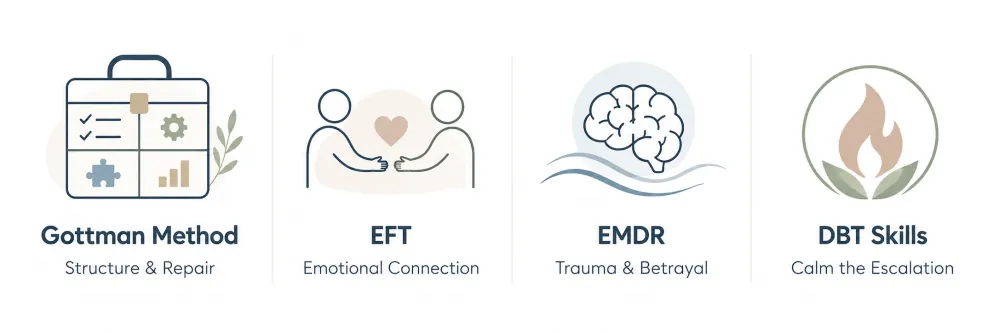
TL;DR: The best therapy for couples communication problems depends on what is driving the conflict. Gottman Method helps with structure and repair, EFT helps with emotional disconnection, EMDR may help when trauma or betrayal is fueling reactions, and DBT skills can help when arguments escalate quickly. Many couples benefit from an integrative approach rather than one single model.
What Is the Best Therapy for Couples Communication Problems?
Here is the answer: it depends on what is actually causing the conflict. The best therapy for couples communication problems depends on the cause.
Gottman Method often fits couples who need structure and conflict tools. EFT often fits couples who feel emotionally disconnected. EMDR may help when trauma or betrayal makes conflict more reactive. DBT skills may help when arguments escalate quickly or partners become emotionally flooded.
I can’t give you one right answer here because not all communication problems come from the same place.
If you’re not sure which approach fits your situation, this article will help you figure that out. Each section below explains what each approach does well and who it tends to work best for. And how trained therapists choose between them.
If you are looking for couples therapy in Columbus, Ohio, you don’t need to know which approach is right before reaching out. That is part of what the first conversation can help clarify.
Why Communication Problems Are Usually Not Just Communication Problems
Many couples who come to therapy say the same thing: “We just can’t communicate.”
But that often means something deeper. The words are not landing. The same fight keeps coming back. One person pushes harder and the other goes quiet. Someone says something they can’t take back, and things never feel right again.
These patterns are rarely about not knowing how to talk. Something else is going on underneath. You feel cut off from each other. Needs aren’t being met. An old wound never fully healed.
The real issue is often not even what you’re fighting about. It is what the fight stirs up inside each of you.
Sometimes you’re not just reacting to what your partner said. You are reacting to what it reminds you of. Old fears. Past hurts. A feeling of not being seen or valued.
One person says something, and it lands poorly. The other says something back, and it triggers their partner. And so the cycle continues.
I call this trauma ping pong. That’s when each partner’s reaction triggers the other, and the original topic gets completely lost.
Knowing what’s driving the problem is the first step toward finding the right kind of help, especially when couples therapy sometimes stalls because the deeper pattern has not been addressed.
When Gottman Method Couples Therapy May Help
Gottman Method Couples Therapy may be a good fit when your arguments never get fully resolved. It also fits when criticism and defensiveness have become habits. When contempt has crept into how you talk to each other. Or when one person goes completely silent and shuts down.
Here is what I want you to understand about this approach. The Gottman Method is built on decades of research into what makes relationships work and what makes them fall apart.
It gives you practical tools. You learn how to bring up a concern without attacking. You learn how to calm things down when they get heated.
You learn how to recover after a fight. And you learn how to rebuild the friendship that holds your relationship together.
According to the Gottman Method Level 1 Training Manual, this approach works across three connected areas. First, handling conflict in a healthy way. Second, rebuilding friendship and intimacy. Third, creating shared meaning together.
Research in the manual shows that about 69% of relationship conflicts are ongoing. That means they come from real personality differences that will not just go away.
The goal is not to solve every argument. It is to learn how to talk about those differences without hurting the relationship.
A 2023 pilot study found that Gottman Method Couples Therapy helped couples heal from affairs better than standard therapy. It improved trust, conflict management, relationship satisfaction, and the quality of sex.
Other research has shown that Gottman couple therapy has a meaningful effect on marital satisfaction and problem-solving styles.
Here is what Gottman Method is not. It is not a trauma therapy.
It works best when the main problem is behavioral. That means the patterns of how you interact have become harmful and you need practical tools to change them.
When emotional disconnection or unresolved trauma is the bigger issue, other approaches may need to be part of the work too. I will explain those next.
When Emotionally Focused Therapy May Help
Emotionally Focused Therapy (EFT) may be the right fit when communication problems are really about you and your partner feeling emotionally cut off from each other. It is not about lacking the right words or skills. You know how to talk. The problem is that you can’t seem to actually reach each other, and the gap between you keeps getting wider.
EFT focuses on the emotional bond between partners and the patterns that slowly wear it down. It works with many kinds of conflict cycles.
Sometimes one partner pushes for closeness while the other pulls away. Sometimes both partners escalate until neither can calm down. Sometimes both partners go so quiet that the relationship starts to feel empty.
Here is when EFT may be worth exploring. You keep getting stuck in the same painful pattern, no matter what the argument is about. Fights feel less like conflict and more like loneliness. One or both of you feel unloved or unseen. Something happened that broke the sense of safety or trust between you.
You have stopped being able to be open or vulnerable with each other. Conversations feel fine on the surface but hollow underneath. Intimacy or sexual connection has been affected by emotional distance.
One or both of you are very emotional and do not want worksheets or a rigid plan. You want to understand what is happening between you without being put in a box.
Emotionally Focused Therapy for couples works by helping partners identify their negative relationship cycles and the emotions under their surface reactions. It helps them change their patterns to express those emotions in ways the other person can actually receive. And it helps them rebuild a sense of emotional safety and connection.
It is one of the most well-researched approaches to couples therapy available. EFT is an evidence-based couples therapy. A major research review found that about 70% of couples who finished EFT were “symptom-free at the end of treatment”. When therapists followed the model closely, couples did even better.
According to the ICEEFT EFT certification program website EFT works well even with severely distressed or highly escalated couples. High distress is not a barrier to success.
It also works well for older or emotionally withdrawn men. It works across different cultures and backgrounds because attachment needs are universal.
When intimacy and sexual connection have been affected, EFT may be especially helpful. A 2024 article in The Family Journal on combining sex therapy with EFT found that 70% to 73% of couples who completed EFT recovered from relationship distress. Between 86% and 90% showed major improvement.
Another study found that sexual satisfaction went up over a two-year period for couples who completed EFT. Improvements in relationship satisfaction led to improvements in sexual satisfaction, not the other way around.
For couples where emotional distance and sexual disconnection are tangled together, this is an important finding.
When EFT May Not Be the Right Starting Point
EFT uses what therapists call “The Four A’s” to decide if couples therapy is safe to start. Treatment is usually put on hold when any of these are present.
Ongoing physical or emotional abuse. Active, unmanaged addictions of any kind.
Continued contact with a third party, or active outside involvement that keeps the partner from fully committing to the relationship.
Goals for the relationship that are incompatible or non-negotiable. If any of these are present, individual support or stability usually needs to come first.
When EMDR May Belong in Couples Work
EMDR is not a couples therapy. It is a treatment designed to help individuals process traumatic memories and experiences. But it can play an important role in couples work when one or both partners are carrying unresolved trauma that is making conflict worse.
When someone has been through difficult or painful events, certain conversations or experiences can set off a reaction that feels much bigger than the moment calls for. The person is not just responding to what their partner said. They are responding to everything that moment reminds their mind and body of.
I see this often in my practice. For example, a woman whose partner raises his voice during an argument might feel a wave of panic that makes no sense in the moment. But if she grew up in a home where yelling meant danger, she is not just reacting to her husband. She is reacting to everything that sound used to mean. That is trauma showing up in the room.
EMDR may be a helpful addition to couples work in many cases. When old trauma is clearly making present-day arguments harder than they need to be. When a partner shuts down completely, panics, or seems to check out during conflict.
When betrayal in the relationship has left one partner with ongoing negative reactions that couples therapy alone is not helping. When fears or reactions from past relationships keep showing up in the current one.
When one or both partners need individual trauma work before couples therapy can really move forward.
EMDR therapy in Columbus, Ohio can be used alongside couples therapy when individual trauma is making present-day conflict more reactive.
When communication problems are specifically connected to betrayal or affair injury, communication-focused couples therapy may not be enough by itself.
When betrayal is part of the picture, it may help to understand that couple therapy does not always heal an affair and what else may need to happen for healing to be possible.
Research in the Journal of Marital and Family Therapy supports combining EMDR and EFT in couples work. A study of therapists trained in both models found that EMDR helped couples get to the root of their negative cycle. It improved self-regulation and made EFT progress more efficient.
Therapists described the combination as filling a “trauma gap” that EFT alone could not always reach.
Recent research on an EMDR couple protocol found that it helped lower trauma-related distress, improve conflict resolution, and increase forgiveness in couples with a history of attachment trauma.
When DBT Skills May Help Couples Communicate
Dialectical Behavior Therapy (DBT) was originally created to help people who struggle with intense, overwhelming emotions. But the skills it teaches are just as useful for couples who find that conflict quickly gets out of hand.
Such as when: Arguments blow up fast. One or both partners get so flooded with emotion that they can’t think clearly. The feelings in the room consistently take over the conversation.
The DBT skills most useful for couples communication include some from each of the 4 pillars; distress tolerance, emotion regulation, mindfulness, and interpersonal effectiveness.
Distress tolerance means learning how to get through a hard moment without making it worse. This includes knowing when to hit pause before a conversation becomes destructive.
Emotion regulation means knowing what you are actually feeling before you react to it. It also means building habits that make you less likely to get flooded in the first place.
Mindfulness means staying present in the conversation instead of reacting to what the argument reminds you of from the past.
Interpersonal effectiveness means asking for what you need in a way that is clear and respectful, while still protecting the relationship.
I see these skills make a difference for many couples. For example, a couple I worked with would go from a mild disagreement to a full-blown fight in a single sentence. Neither could slow down enough to hear the other.
The first thing I needed to teach them was distress tolerance. They learned skills to bring down the level of emotional intensity. That one skill changed the whole dynamic of their arguments.
DBT skills may be especially helpful when one partner goes completely silent during conflict, when someone says something harmful in the heat of the moment, or when neither person can slow down long enough to actually hear the other.
These skills don’t replace couples therapy. They make it easier to participate by helping both partners stay calm enough to do the work.
Research on DBT and emotion regulation supports the effectiveness of these skills for reducing emotional reactions and impulsive behavior.
A study on DBT-informed couples therapy found that using DBT skills in couples work can improve communication outcomes, especially when out of control emotions are a main barrier.
A pilot study of a couple-based program that combined DBT and cognitive-behavioral couple therapy found large treatment effects. Couples showed less emotion dysregulation and more confidence in each other’s ability to manage emotions.
Another study of 20 couples with marital distress and emotion dysregulation found that DBT for couples led to major improvements in both emotion regulation and marital adjustment.
Gottman vs. EFT vs. EMDR vs. DBT: Which Is Best?
No single approach is best for every couple. The right fit depends on what is driving the communication breakdown.
Here is a clear comparison to help you decide.
| Approach | Best When |
| Gottman Method | You want structure, homework, and a clear plan for conflict, repair, and rebuilding friendship |
| Emotionally Focused Therapy | You feel emotionally disconnected, are stuck in a conflict cycle, or intimacy has been affected by emotional distance. Best for couples who are highly emotional or who do not want a worksheet-driven approach |
| EMDR integration | Trauma, betrayal, or attachment wounds are making conflict more reactive than the situation warrants |
| DBT skills | Arguments escalate quickly, partners flood emotionally, or communication falls apart under stress |
| Integrative approach | More than one pattern is present at the same time, or EMDR/DBT need to be used with the couple therapy method |
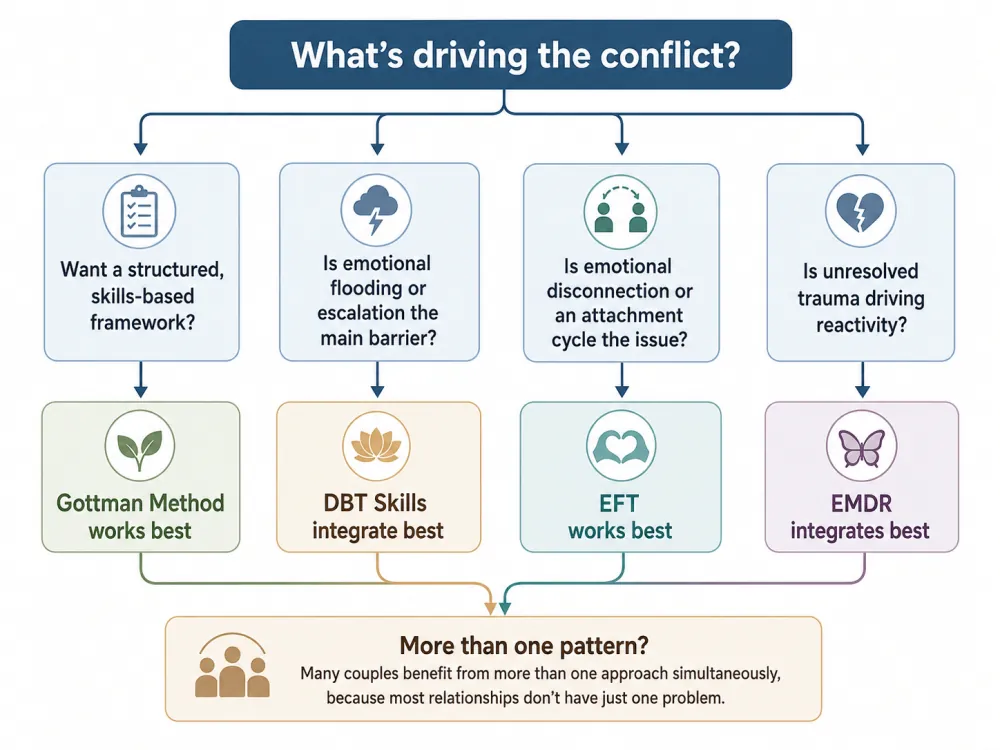
Gottman Method works best for couples who want a structured, skills-based framework. EFT works best for emotional disconnection and attachment cycles.
EMDR is best integrated when unresolved trauma is driving reactivity. DBT skills are best integrated when emotional flooding or escalation is the main barrier.
Many couples benefit from more than one approach simultaneously, because most relationships don’t have just one problem.
The most important thing is not which approach is most popular. It is which approach addresses what is actually happening in your relationship.
A skilled couples therapist will look at your specific patterns before recommending a direction. They will not apply the same model to every couple who walks in the door.
Which Therapy Approach Fits Your Relationship Pattern?
Use the patterns below as a starting point. They are not a diagnosis. A therapist will help you identify what is actually happening and what approach may be most appropriate for your situation.
If you keep having the same fight
The argument changes topics but the feeling is always the same. You end up in the same place every time, and nothing ever fully resolves.
This usually points to an underlying emotional cycle, not a content problem. EFT may help by identifying what the cycle is actually about emotionally. Gottman Method may help by giving you tools to interrupt the pattern and repair more effectively.
If one partner shuts down
Stonewalling, or going completely silent during conflict, is one of the most common and most damaging patterns in relationships. It is usually not indifference. It is overwhelm. The nervous system has hit its limit and the person goes offline.
DBT distress tolerance skills may help the shutting-down partner stay present longer. Gottman Method offers specific tools for recognizing and interrupting this pattern.
If shutdown is connected to trauma, EMDR may be part of the picture as well if the overwhelm is caused by trauma.
If arguments escalate quickly
When conversations go from calm to crisis in minutes, emotional regulation is usually the culprit.
DBT skills may help both partners slow down the escalation. Gottman Method recommends the use of de-escalation tools and offers structured ways to bring up difficult topics.
If the escalation is driven by trauma triggers, EMDR may support the underlying work.
If betrayal changed the relationship
Betrayal changes a relationship in ways that communication skills alone may not fix. This includes affairs, broken trust, or major deception.
Gottman Method has a structured method for affair recovery. EFT may help rebuild emotional safety and attachment. EMDR may help process the trauma of the betrayal itself.
Standard communication-focused couples therapy may not be enough without also addressing the injury directly.
If past trauma gets activated during conflict
When a current argument triggers something much older, the conversation is no longer just about the present. One or both partners may be responding to a history the other person can’t see.
EMDR may help process the underlying material so it has less power over present-day interactions. EFT can help partners understand each other’s emotional history and respond to each other with more accuracy.
Why an Integrative Approach Can Work Better Than One-Size-Fits-All Couples Therapy
Most couples who come to therapy don’t have one neat, simple problem. They are dealing with emotional distance AND a history of fights that never got resolved AND a nervous system that hits the wall under pressure.
Treating only one of those layers usually leaves the others untouched.
An integrative approach means the therapist is not locked into one method. They combine approaches in a specific way depending on what the couple needs.
Early sessions might focus on helping both partners stay calm enough to actually be in the room together. Later sessions might go deeper into the emotional bond and the old wounds underneath the surface conflict.
Individual trauma work might happen alongside couples sessions when that is what is needed.
The real question is not “which therapy is best?” It is “which combination of approaches fits this particular couple?”
At Revitalize You, the goal is to match the therapy to the couple, not fit every couple into the same box.
I draw from Gottman Method, Emotionally Focused Therapy, EMDR, DBT skills, and family therapy depending on what the couple actually needs.
I do not just mix things together at random or try things at whim. It is using the right tool for the right problem.
Couples Therapy in Columbus, Ohio
Revitalize You offers couples therapy with in-person sessions in Columbus and online therapy is available throughout Ohio. Couples do not need to live in Columbus to access this service.
Telehealth sessions make it possible to work with a highly trained therapist no matter where you are in the state.
Therapy at Revitalize You may include Gottman Method Couples Therapy, Emotionally Focused Therapy, EMDR integration, DBT skills, and other types of therapy, depending on what the couple’s situation calls for.
The goal is not to apply a fixed protocol but to identify what is actually driving the communication breakdown and address it directly.
If you’re unsure whether couples therapy is the right next step, or which approach might fit your situation, a consultation can help clarify that. You don’t need to have it figured out before you reach out.
When Couples Therapy May Not Be Enough
Couples therapy can help in many situations, but it is not the right first step in all of them.
The Gottman Method Level 1 Training Manual lists specific times when couples therapy is not advised. Most evidence-based approaches share similar cautions.
Couples therapy may not be appropriate, or may need to be paused, when there is an ongoing affair that has not been disclosed. Couples therapy can’t work well when one partner in a monogamous relationship is participating in more than one relationship. The Gottman manual says that active affairs are a clear reason to pause couples therapy.
It is also not appropriate when there is severe domestic violence. When violence is extreme, one-sided, and used to control or scare the other person, couples therapy is not the right choice as it can be a safety risk.
Individual support and safety planning should come first.
Note that situational violence, where milder conflict gets out of hand without a clear pattern of control or injury, is different and may be addressable in couples work. A skilled therapist can help you tell the difference.
Other times to pause include other types of active abuse or coercive control. Couples therapy is not designed to fix power imbalances where one partner’s safety is at risk.
Severe untreated addiction also makes couples therapy unproductive or even harmful. Active substance use that is not being treated on its own needs to be addressed first.
Serious mental health issues may also need to come first. Acute psychosis, severe depression, or high suicide risk may need to be stabilized individually before couples work can be effective.
Couples therapy also requires real effort from both people. If one partner is unwilling to participate, one person can’t do it alone.
Finally, individual trauma therapy may be needed alongside or before couples work. In some cases, individual trauma processing needs to happen first before the couple can effectively do relational work together.
If you’re unsure whether your situation is right for couples therapy, a clinician can help you think through what the best starting point might be.
How to Get Started With Couples Therapy
If you and your partner are ready to take a next step, Revitalize You accepts new couples for therapy. You don’t need to know which approach is right for you before reaching out.
That is part of what the initial consultation is for.
To get started, contact Revitalize You to schedule a consultation or ask whether a particular approach may be appropriate for your situation.
In-person sessions are available in Columbus. Online therapy is available throughout Ohio.
About the Author
Yvonne Judge, EMDRIA Certified Therapist and Consultant, is an IMFT-S (Supervisor), EMDRIA Certified Therapist, and EMDRIA Approved Consultant.
She is certified in DBT and trained in Gottman Method Couple Therapy, Emotionally Focused Therapy.
She specializes in couples therapy, trauma, personality disorders, neurodivergence, and integrative approaches that address both the relational and neurological dimensions of healing.
Yvonne works with couples in Columbus and throughout Ohio via telehealth.
Frequently Asked Questions
What type of therapy is best for couples communication problems?
The best therapy depends on what is driving the communication problem. Gottman Method may help when conflict patterns are behavioral and the couple needs practical tools.
Emotionally Focused Therapy may help when emotional disconnection or attachment injury is the core issue. EMDR may help when trauma or betrayal is making reactions stronger.
DBT skills may help when arguments escalate quickly or emotional flooding is frequent. Many couples benefit from more than one approach.
Is Gottman Method or EFT better for couples?
Neither is better for everyone. Gottman Method is more skill-based and structured. It focuses on conflict management, repair, and friendship.
EFT goes deeper into the emotional bond and attachment patterns.
If you need practical tools and a clear framework, Gottman may be a stronger starting point. If the main issue is emotional disconnection or an attachment injury, EFT may be more appropriate.
Some couples benefit from parts of both.
Can EMDR help couples with communication problems?
EMDR is not a couples therapy, but it can support couples work when trauma or past wounds are making present-day conflict more reactive.
If one or both partners have unresolved trauma that gets activated during arguments, individual EMDR may reduce that reactivity and make couples therapy more effective.
A therapist trained in both EMDR and couples work can help assess whether this is right for you.
Why do we keep having the same fight?
Recurring arguments usually signal an underlying emotional cycle, not a content problem. The topic changes but the feeling stays the same because the fight is not really about the topic.
It is about an unmet need, a fear, or an attachment wound that keeps getting activated. EFT is designed to identify and interrupt these cycles by looking at what is happening emotionally underneath the surface argument.
What if one partner shuts down during arguments?
Shutdown during conflict is usually a sign of emotional overwhelm, not disengagement or indifference. The nervous system has reached its limit and the person goes offline to protect itself.
DBT distress tolerance skills may help the shutting-down partner build more capacity to stay present. Gottman Method has specific tools for recognizing and working with stonewalling.
If the shutdown is connected to trauma, EMDR may also be relevant.
Can couples therapy help after betrayal or an affair?
Couples therapy may help after betrayal, but the approach matters a lot. Standard communication-focused therapy is often not enough on its own when betrayal trauma is present.
EFT may help rebuild emotional safety and attachment. EMDR may help process the trauma of the betrayal itself.
The couple’s specific situation, including whether the affair has ended, whether both partners are willing to engage, and whether safety and transparency have been established, will shape what kind of help is appropriate.
Do you offer couples therapy in Columbus, Ohio?
Yes. Revitalize You offers couples therapy with in-person sessions in Columbus and online therapy available throughout Ohio.
Therapy may include Gottman Method, Emotionally Focused Therapy, EMDR integration, DBT skills, and marriage and family therapy depending on the couple’s needs.
