
[vc_row][vc_column][vc_column_text]
 Your Trauma is Not Treatment-Resistant. You Just Haven’t Had the Right Treatment.
TL;DR: This article explains why trauma is often misdiagnosed, why the right treatment approach matters, and how EMDR can work best when it is properly prepared and integrated with other therapies like DBT.
Has someone told you that you or your trauma is difficult to treat? Maybe they said that healing takes time, and you need to be patient. It’s possible they told you that some people just respond more slowly to therapy. Or even that the work you’ve been doing in therapy is valuable even if it doesn’t feel that way yet.
What they were actually saying is that the way they knew how to do therapy wasn’t working for you. That’s a different problem.
Why the Right Diagnosis Comes Before the Right Treatment
PTSD is often misdiagnosed, sometimes for decades. It looks like depression. It looks like anxiety. It presents as bipolar disorder, OCD, and personality disorders. A therapist who doesn’t recognize the trauma underneath those symptoms treats the wrong thing. When you treat the wrong thing, nothing changes. Not because the person is treatment-resistant. Because the treatment doesn’t match the actual problem.
It’s like using antibiotics meant for a bacterial infection to treat your broken leg. The antibiotics are effective. For an infection. Meanwhile your broken bone just gets worse.
This happens more than most people realize. And it can go on for years. Sometimes for decades. The person who has been in therapy for ten years with no real progress isn’t broken. They’re almost always dealing with unprocessed trauma or another issue that hasn’t been correctly identified.
 You Had Therapy and it Didn’t Work
Talk therapy, poorly done EMDR, CBT, or “Treatment” from someone who describes their approach as eclectic.
Eclectic means your therapist uses whatever feels right in the moment. There’s no framework. No clinical map for where you’re going. No way to evaluate what’s working and adjust when it isn’t. It’s improvised care.
CBT is a legitimate, structured model. It works for a range of issues. For trauma, it has a ceiling. Trauma isn’t stored in the narrative parts of your brain. You can tell the story, identify the cognitive distortions, do every worksheet, and still feel it the same way you did when it happened. CBT doesn’t reach where trauma lives in the body and nervous system. There is a specific type of CBT meant to treat trauma called Trauma Focused CBT (TF-CBT). Most CBT trauma therapists aren’t trained in it. Some have never heard of it.
Talk therapy, done well, is valuable. Done without clinical structure, it’s a friendly conversation with someone who has a license. That’s not the same thing. And really, if you want a conversation where you trauma dump, you don’t have to pay by the hour to do so. And your listener doesn’t need a license to be your “bestie”.
 What Bad EMDR Looks Like
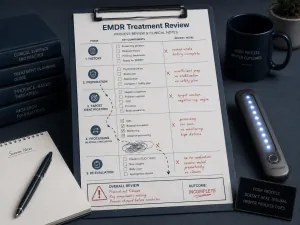
Many people who come to me have tried EMDR. A significant number had an experience that didn’t work. Sessions that stirred things up without resolving them. Leaving more activated than when they came in. Memories that felt more present after treatment than before it. I have had several clients come to me asking for another type of treatment because “EMDR doesn’t work” or “It made things worse” or “I was such a mess after for weeks on end” and they are afraid to go anywhere near EMDR therapy again.
That’s not what EMDR looks like when it’s done correctly.
While there are several types of EMDR, most therapists are doing traditional, 8-Phase EMDR. This style of EMDR has required preparation phases. These aren’t optional. Before any processing begins, a client needs sufficient internal stability and resources or the EMDR can make things worse. An undertrained therapist rushes or skips preparation. They may not know how to identify the right target memories. They may not recognize when a client isn’t ready to process.
If EMDR didn’t work for you, the most likely reason isn’t that EMDR doesn’t work. It’s that the person administering it didn’t have adequate training.
EMDRIA certification requires advanced, EMDR-specific training, supervised practice hours, and ongoing continuing education. An EMDR training from an unrecognized vendor and an EMDRIA certification are not the same thing. The difference matters.
That being said, several of those clients who were terrified of EMDR that I mentioned ended up later accepting EMDR from me after we’d developed some trust. I started them out with the preparation phases. I started them with a low-intensity memory (a 2 or 3 on a scale of 10) first instead of going for the worst thing that had ever happened to them. That way, if they felt it didn’t work then there was no harm in it. We would process things like “some jerk cut me off in traffic today” or “the coffee shop got my order wrong” as a test so they could see how EMDR was supposed to feel.
Once they were successful in treating those memories, they gained more confidence with the process, and with their ability to heal. Then we moved on to things that were more upsetting and were able to successfully process them.
For some, instead of using traditional 8-Phase EMDR, we opted to switch to another style such as EMDR Flash.
 What Changes With the Right Approach
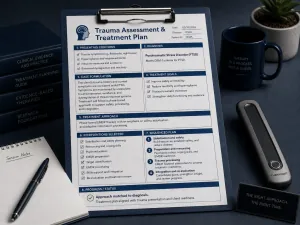
Treatment at Revitalize You starts with a thorough intake. I need to understand your full history, what’s been tried, why it didn’t move things, and what’s actually underneath the presenting problem. That assessment shapes everything that comes next.
EMDR processing doesn’t require you to narrate your trauma in detail. It doesn’t take years. If something isn’t moving in about four or five sessions, I re-evaluate. What are we targeting? How are we approaching it? What needs to change? That kind of accountability is not unusual. It’s what treatment based on an actual plan looks like.
EMDR alone also isn’t the complete picture for most clients. Trauma removes the emotional charge from a memory. But trauma leaves you with some really ineffective ways of coping. They may have worked at the time when the original trauma happened. But they do not work now. EMDR doesn’t automatically replace the coping patterns the trauma created. Until you build new coping skills, you will continue to do the same things that were not working. You just may not feel as upset as often as before. Integrating Dialectical Behavior Therapy (DBT) builds new skills alongside the processing work. That combination gives you something to stand on when the processing is done.
Notice that I said integrated, not eclectic. Integration is when you pull in another therapy model because the first one doesn’t quite address everything that is needed. EMDRIA teaches EMDR therapists how to integrate other models such as DBT and IFS into EMDR treatment. What it does not teach them is to fly by the seat of their pants and do whatever feels good in the moment without rhyme or reason.
Click here to learn more about how EMDR works and the four approaches we use at Revitalize You
| If you’ve been told you’re difficult to treat, one question is worth sitting with: difficult for whom, using which approach? Free consultations are available. We see clients in person or via video in our Columbus office, and throughout the state of Ohio via telehealth. |
[/vc_column_text][/vc_column][/vc_row]
