

Couple clutching each other
About intimate partner violence
The definition of intimate partner violence
According the U.S. Department of Health & Human Services (2020), “intimate partner violence’ (IPV) describes physical violence, sexual violence, stalking, or psychological harm by a current or former partner or spouse.”
Intimate partner violence (IPV) is not limited to heterosexual couples, but can hap-pen between same-sex partners (U.S. Department of Health & Human Services , 2020). It is also the case that a couple does not have to be having sex for IPV to be a problem.
This guide is intended to provide resources to those experiencing IPV and their loved ones. These resources include identification of IPV and resources to get help with IPV.
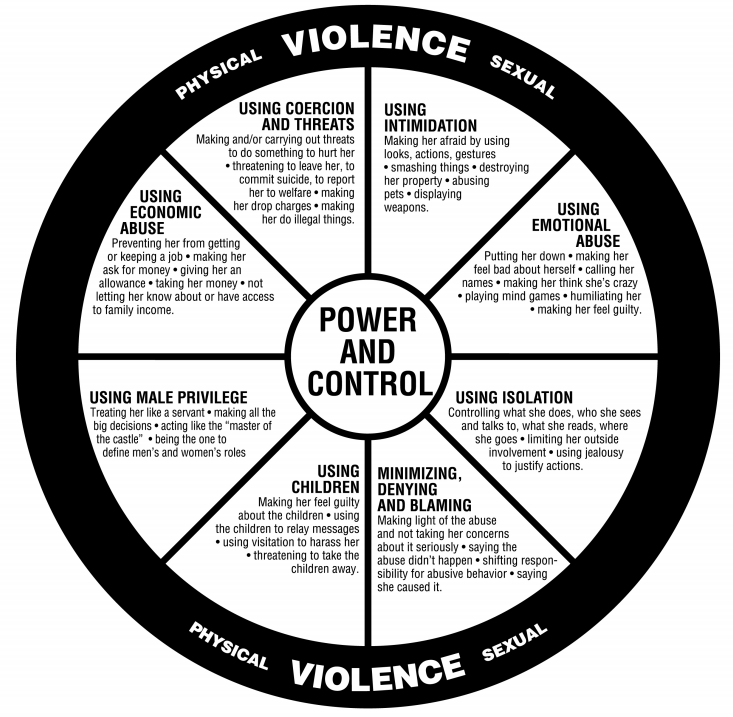
Wheel of Power and Control from https://www.thehotline.org/
Types of intimate partner violence
The CDC recognizes the following types of IPV:
- Physical violence (U.S. Department of Health & Human Services , 2020).
- Physical abuse, including, but not limited to hitting, kicking, slapping, punching or using a weapon.
- Sexual violence
- This is trying to force or succeeding in forcing a partner to take part in a sexual act whether physical or non physical. This can include, but is not limited to, intercourse, sexual touching, or sexting.
- Stalking
- Stalking is when a partner or former partner repeatedly contacts or both-ers someone who does not wish the attention. Stalking leads to fear for the victim’s safety or for the safety of someone close to the victim.
- Psychological aggression
- Verbal and non-verbal abuse. This is using verbal or nonverbal means to mentally or emotionally hurt some-one or to control them.
Another take on IPV can be seen in the Wheel of Power and Control from https://www.thehotline.org/. Please note that while this wheel is intended for females experiencing IPV, all of these categories apply to men experiencing IPV as well. I have removed the gendered language below. This wheel shows both physical and nonphysical violence and lists the following categories:
- Using coercion and threats
- making and/or carrying out threats to do something to hurt them
- threatening to leave them, commit suicide or report them to welfare
- making them drop charges
- making them do illegal things
- Using intimidation
- making them afraid by looks actions and gestures
- smashing things
- destroying their property
- abusing pets
- displaying weapons
- Using emotional abuse
- putting them down
- making them feel bad about themselves
- calling them names
- making them think they’re crazy
- playing mind games
- humiliating them
- making them feel guilty
- Using isolation
- controlling what they do, who they see and talk to, what they read, where they go
- limiting their outside involvement
- using jealousy to justify actions
- Minimizing, denying and blaming
- making light of the abuse and not taking their concerns about it seriously
- saying the abuse didn’t happen
- shifting responsibility for abusive behavior
- saying they caused it
- Using Children
- making them feel guilty about the children
- using the children to relay messages
- using visitation to harass them
- threatening to take the children away
- Using privilege
- treating them like a servant
- making all the big decisions
- acting like master of the castle
- being the one to define gender roles
- Using economic abuse
- preventing them from getting/keeping a job
- making them ask for money
- giving them an allowance
- taking their money
- not letting them know about or have access to the family income
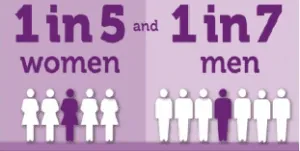
IPV numbers
Prevalence of intimate partner violence
It’s difficult to know how much IPV actually happens since rates rely heavily on self report data. However, according the NCADV: (2021), IPV is very common:
- 1 in 4 women experience severe IPV physical violence, sexual contact violence or stalking.
- 1 in 3 women have been the victim of some form of physical violence IPV
- 1 in 7 women have been injured by IPV
- 1 in 10 women have been the victim of rape by an intimate partner
- 1 in 7 women has been the victim of stalking
- 1 in 9 men experience severe IPV physical violence, sexual contact violence or stalking.
- 1 in 4 men have been the victim of some form of physical violence IPV
- 1 in 25 men have been injured by IPV
- 1 in 18 men has been the victim of stalking
- 15% of violent crime is IPV
Consequences of intimate partner violence
IPV has serious economic and mental health consequences (NCADV, 2021). These impacts include, but are not limited to:
- Lost work days / Job loss
- Higher likelihood of contracting STDs
- Higher risk of depression and suicidal behavior
- Unintended pregnancy
- Intrauterine hemorrhage
- Chronic pain
- PTSD
- Disability
- Anxiety
- Higher prevalence of addiction
- Neurological disorders
- High blood pressure
- Nutritional deficiencies
- Abdominal pain
- Gastrointestinal issues
Preventing domestic violence
According to the U.S. Department of Health & Human Services, these are a few things that can help prevent IPV:
- Teaching relationship skills that are healthy and safe
- Engaging influential adults and peers
- Disrupting developmental pathways toward intimate partner violence
- Creating environments that protect against domestic violence
- Strengthening economic support for families
- Support IPV survivors to increase safety and lessen the potential of ongoing IPV
Hand signal to get help for IPV
Getting help for IPV can be difficult if your partner is always around. The video below shows the Stop Violence At Home Signal For Help and how to use it.
Treatments for intimate partner violence
- The below treatments have been found to be effective for dealing with the effects of IPV:
- EMDR (Vuong, 2019)
- EMDR has been found to be effective for the trauma resulting from IPV.
- Narrative Exposure Therapy (Orang, 2018)
- Narrative Exposure Therapy is effective in working with women who currently live in situations with ongoing IPV.
- Cognitivee Behavioral Group Therapy (Nesset, 20200
- Cognitive behavioral group therapy helps reduce IPV behavior in men.
- Mindfulness-Based Stress Reduction Group Therapy (Nesset, 2020)
- Mindfulness Based Stress Reduction Group Thera-py helps reduce IPV behavior in men.
- Trauma-Informed Art and Play Therapy (Woollett, 2020)
- This type of therapy has been shown to help chil-dren manage challenging behavior stemming from witnessing parental IPV.

Law
Legal services for intimate partner violence
Below are legal services that can help with you IPV case as needed.
The Legal Aid Society of Columbus
1108 City Park Ave, Suite 101
Columbus, OH 43206
614-224-8374
https://www.columbuslegalaid.org/
Ohio Domestic Violence Network
4807 Evanswood Drive Suite 201
Columbus, OH 43229
800-934-9840
https://www.odvn.org/
Capital University Law School Legal Clinic
303 East Broad Street
Columbus, OH 43215
614-236-6245
Jewish Family Services
1070 College Avenue
Columbus, OH 43209
614-358-2530

helping hand
Social services for domestic violence
Domestic violence shelters
Huckleberry House
1421 Hamlet Street
Columbus, OH 43201
614-294-5553
The Lighthouse
740-687-4423
Lutheran Social Services
614-224-HOME (4663)
Identifying abuse
Domestic violence hotline
CHOICES for Victims of Domestic Violence (Franklin County)
(614) 224-4663 24/7 crisis line
National Domestic Violence Hotline
(800) 799-SAFE (7233) 24/7 hotline
IPV therapy and counseling
If you are experiencing IPV in your relationship there is help available. There are therapists work work with people who are receiving IPV or have received it in past. There are therapists who work with people who are the aggressor in IPV who want to stop and gain control of their actions.
Depending on the state you are located in, it may or may not be legal to do couple therapy for IPV. If so, most therapists will only work with couples who have “light” IPV or they will have different protocols for couples who are experiencing IPV. These different protocols (or even refusing services) is to keep the couple safe. Safety is the FIRST GOAL when it comes to working with those experiencing IPV.
That being said, I know it can be tempting to not report IPV to your therapist if it means you may not have access to couple therapy. However, I encourage you to be transparent with your therapist or counselor about what is going on. If the IPV is emotional, physical and/or mental and the extent of it.
You can ask what confidentiality covers before sharing information. My article about secrets and confidentiality in couples therapy explains how I handle disclosures involving physical abuse and safety concerns.
References
Kelly, J. B., & Johnson, M. P. (2008). Differentiation among types of intimate partner violence: Research update and implications for interventions. Family Court Review, 46, 476-499.
Orang, T., Ayoughi, S., Moran, J. K., Ghaffari, H., Mostafavi, S., Rasoulian, M., & Elbert, T. (2018). The efficacy of narrative exposure therapy in a sample of Iranian women exposed to ongoing intimate partner violence—A randomized controlled trial. Clinical Psychology & Psycho-therapy, 25(6), 827–841. https://doi-org.proxy1.ncu.edu/10.1002/cpp.2318
NCADV: National coalition against domestic violence. (2021). Statistics. Retrieved March 22, 2021, from https://ncadv.org/STATISTICS
Nesset, M. B., Lara-Cabrera, M. L., Bjørngaard, J. H., Whittington, R., & Palmstierna, T. (2020). Cognitive behavioural group therapy versus mindfulness-based stress reduction group therapy for intimate partner violence: a randomized controlled trial. BMC Psychiatry, 20(1), 178. https://doi-org.proxy1.ncu.edu/10.1186/s12888-020-02582-4
United States Census Bureau. (2021). U.S. census bureau quickfacts: Columbus CITY, OHIO. Retrieved March 26, 2021, from https://www.census.gov/quickfacts/columbuscityohio
U.S. Department of Health & Human Services. (2020, October 09). Intimate partner violence |violence prevention|injury center|cdc. Re-trieved March 22, 2021, from https://www.cdc.gov/violenceprevention/intimatepartnerviolence/index.html
Vuong, T. (2019). The efficacy of eye movement desensitization and reprocessing (EMDR) in the treatment of victims of domestic violence [ProQuest Information & Learning]. In Dissertation Abstracts International: Section B: The Sciences and Engineering (Vol. 80, Issue 7–B(E)).
Woollett, N., Bandeira, M., & Hatcher, A. (2020). Trauma-informed art and play therapy: Pilot study outcomes for children and mothers in
